
European Union (EU) vs Schengen Zone (or simply Schengen)
For anyone outside of Europe, these two terms are either overlapped or confused. Let me explain shortly what they mean and how to distinguish them.
Although they might sound familiar at a first glance and Schengen Zone overlaps EU territory, both involve free movement between its member countries, they are not the same. So let’s start with the first one.
Important: NOT all EU countries are Schengen members and NOT all Schengen members are EU countries.
EUROPEAN UNION (EU) – short history
- It has been established after the aftermaths of World Wars
- Its predecessor, The European Economic Community, was founded by 6 countries: Belgium, France, Italy, Luxembourg, the Netherlands and West Germany
- The EU as we know it today was formally established in 1993 and the criteria for candidate members was established.
- In 2002 Euro banknotes and coins replaced the national currencies of 12 countries and now has increased to 21 countries
- In 2012 it received the Nobel Peace Prize
- The first sovereign country to exit the EU was United Kingdom, also known as Brexit
EU – how it works?
- It establishes directives (which are then implemented in the national legislation of its member states) and regulations (which are immediately enforceable)
- It has a common budget
- The EU Council sets the broad political direction
- The EU Commission is responsible for the day-to-day activities of the EU and is also the legislative initiator – they ONLY propose laws for debate
- The Council of the EU (not to be confused with the one above) consists of a representative from each member’s government and they meet depending on the policy area being addressed
- The European Parliament amends and approves the laws proposed by the EU Commission. Currently there are 705 members, elected every 5 years by EU citizens
- The EU Court of Justice – interpreting the EU law and ensuring uniform application in its member states
- European Central Bank – responsible for monetary policy
- As it has been built and enforces democratic values, joining and leaving must be preceded by referendum (the citizens have to vote if they want their country to join or leave EU).
- It has its own flag and anthem – Ode of Joy, part of Beethoven’s 9th Symphony
EU MEMBER STATES:
| Country | Capital City | Language | Currency | Political Regime |
Austria  | Vienna | German | Euro | Republic |
Belgium  | Brussels | Dutch, French, German | Euro | Kingdom |
Bulgaria  | Sofia | Bulgarian | Euro | Republic |
Croatia  | Zagreb | Croatian | Euro | Republic |
Cyprus  | Nicosia | Greek, Turkish | Euro | Republic |
Czech Republic  | Prague | Czech | Czech Koruna | Republic |
Denmark  | Copenhagen | Danish | Danish Krone | Kingdom |
Estonia  | Tallinn | Estonian | Euro | Republic |
Finland  | Helsinki | Finnish, Swedish | Euro | Republic |
France  | Paris | French | Euro | Republic |
Germany  | Berlin | German | Euro | Federal Republic |
Greece  | Athens | Greek | Euro | Republic |
Hungary  | Budapest | Hungarian | Hungarian Forint | Republic |
Ireland  | Dublin | English, Irish | Euro | Republic |
Italy  | Rome | Italian | Euro | Republic |
Latvia  | Riga | Latvian | Euro | Republic |
Lithuania  | Vilnius | Lithuanian | Euro | Republic |
Luxembourg  | Luxembourg | German, French, Luxembourgish | Euro | Duchy (monarchy) |
Malta  | Valetta | Maltese, English | Euro | Republic |
Netherlands  | Amsterdam, The Hague | Dutch | Euro | Kingdom |
Poland  | Warsaw | Polish | Polish Zloty | Republic |
Portugal  | Lisbon | Portuguese | Euro | Republic |
Romania  | Bucharest | Romanian | Romanian Leu | Republic |
Slovakia  | Bratislava | Slovak | Euro | Republic |
Slovenia  | Ljubljana | Slovene | Euro | Republic |
Spain  | Madrid | Spanish | Euro | Kingdom |
Sweden  | Stockholm | Swedish | Swedish Krona | Kingdom |
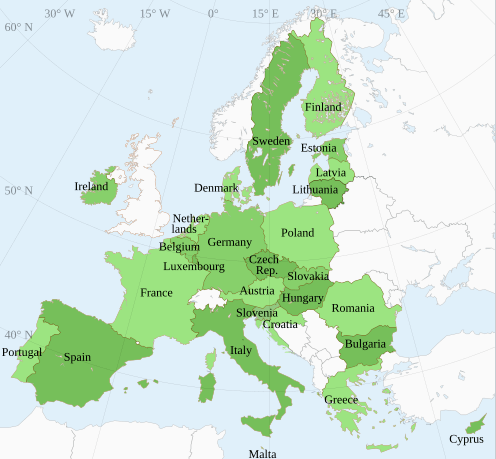
EU member countries – map
EU perks and benefits: **DISCLAIMER: these only apply to EU citizens and residents!**
- Free movement between its member states
- You can work in one country but reside in another and social contributions are counted
- For example, I reside in Romania but I work in Bulgaria. As I am employed by a Bulgarian company, I pay taxes to the Bulgarian state. These are taken into consideration upon retirement or for medical care, for example
- No need for passport or visas when travelling from one country to another, EU citizens can use their national ID
- If I want to travel from Greece to France, I don’t need a passport, I just use my national ID at boarding, passport control or in any other situation when an ID is required
- For short term travels or for studies, we can use the European Health Card, which is free, but sometimes topped with a travel medical insurance
- In case of medical emergency, we can use the EHC and our national ID in any member state. This applies only to public hospitals
- No roaming costs
- If I am from Romania but on vacation in Germany, I can talk to my mom back home or use the mobile data from my home subscription with NO additional costs. No need to buy a local SIM or an e-SIM.
- We can work remotely from any EU member state for up to six months, without any visa
- This applies to digital nomads or remote workers. If you don’t like the cold Swedish winter you can take your laptop and go work from sunny and warm Cyprus, Greece or Malta. Of course, this is subject to employer policies
- Free circulation of goods, capital, people and services
- If you are self-employed you can offer services in any member state
- No extra customs tax for goods
- If I order something online from Belgium and it has to be shipped in Italy, I will not pay any custom tax and the parcel will be delivered directly at my door
- GDPR – General Data Protection Regulation and EU data boundaries
- Some harmful substances have been completely banned
- Both governments and citizens can access European funds, as credit or non-reimbursable
- Governments: for infrastructure (highways, bridges, hospitals, buildings, cultural sites, etc)
- Citizens: mainly for agriculture, tourism or sustainable energy
And the list can go on
Schengen Zone
Although it overlaps with EU territory, Schengen area consists of 29 countries where border controls and therefore passport control has been abolished. What does this mean? Well, I can go from Athens to Lisbon by car or by train with NO passport control. Or I can fly from Rome to Helsinki and the only place where I will show my ID or passport is at the boarding gate 😊
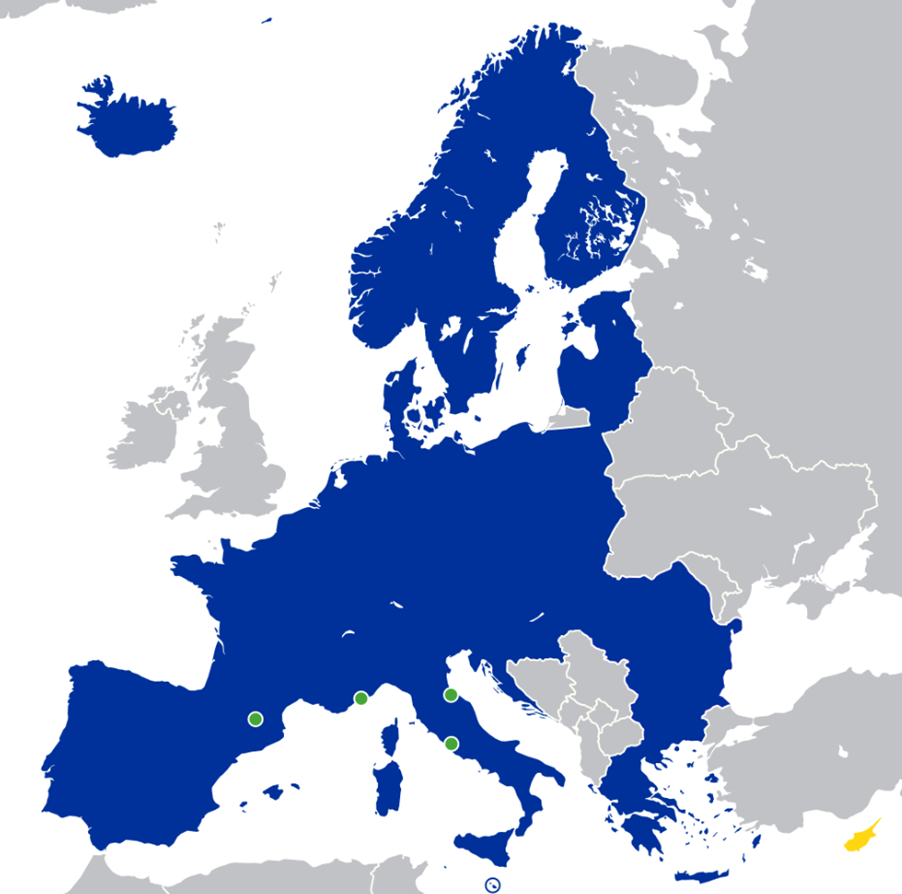
Schengen area means 25 EU member states – Ireland and Cyprus are not members of Schengen. Ireland chose to opt-out and implement its own visa policies and Cyprus is aiming to join the area by the end of 2025 – and 4 non-EU Member states: Iceland, Switzerland, Liechtenstein and Norway. Micro-states such as Andorra, Monaco, San Marino and Vatican are de-facto Schengen members, since there literally no borders between them and neighbouring states (Italy, France, Spain).
Schengen area map:
- Blue – member states
- Green – de facto member states – Monaco, Andorra, San Marino and Vatican
- Yellow – states committed to join in a near future (Cyprus)
All member countries have separate terminals or gates dedicated to Schengen area (usually combined with domestic flights) and for non-Schengen (where booths are placed and border police will perform passport control or immigration process) at their international airports.
NOTE: Border police can perform random checks in airports, either at disembarking or before boarding or at land borders! Travelling between Schengen countries will still require a valid travel document (ID for EU citizens or passport for non-EU)! Driver’s license, resident permit or birth certificate are NOT travel documents!
Let’s take some practical examples.
Schengen zone:
- I am flying from Rome to Lisbon. Once I arrive at the airport, I will just go through security check. No passport control, I will show my ID/passport (if you are not EU citizen) ONLY at the boarding gate.
- I am flying from Bucharest to Amsterdam with a connection flight in Athens. Since all three countries (Romania, Netherlands and Greece) are Schengen members, when I will change the plane in Athens I will not change the terminal and not go again through security check or passport control.
- I am travelling by car from Italy to Greece, more exactly from Venice to Thessaloniki. My mobile carrier has huge costs for non-EU countries and I need mobile data for Waze or Maps, so I will choose to go through EU and Schengen countries. My route is: Italy – Slovenia – Hungary – Romania – Bulgaria – Greece. There will be NO passport control between all these countries, I might notice I have crossed the borders when I will receive the message from my mobile operator “Welcome to … “ or when I will see the former border police booths 😊
Outside of Schengen zone:
- I am flying from Prague to Belgrade. Czech Republic is in Schengen, but Serbia is not. Therefore, my flight will depart from the non-Schengen terminal at Prague Airport and after security check I will go through passport control. The same will happen when I will arrive in Belgrade. Same procedure will apply when I return
- I am flying from Budapest to Dubai with a connection flight in Bucharest. Hungary and Romania are Schengen members, therefore I will not go through passport control in Budapest at departure and in Bucharest at arrival. When I will change planes in Bucharest, I will go to the non-Schengen departures area and go through Passport control before boarding gate to Dubai. Same thing when I return.
- I am flying from New York to Athens with a connection in Munich. Upon arrival in Munich, I will go through passport control and immigration process in Munich and then change terminal for intra-Schengen. There will be NO passport control when I depart to Athens
- I am travelling by car from Greece to Croatia. The shortest route is Greece – Albania – Montenegro – Croatia. Albania and Montenegro are not Schengen and European Union members. Therefore, there will be passport control at Greece – Albania border, Albania – Montenegro and Montenegro – Croatia. When entering an EU country from non-EU, you must declare the goods and the customs officers can perform luggage check, especially for cigarettes and alcohol, due to restrictions. These goods are much cheaper, even half the price in these countries compared to EU states and large quantities can be retained at the customs, as they are considered for commercial purposes (reselling). For example, a packet of cigarettes is around 2.5 euros in Albania, but in Greece or Croatia the price starts from 4 euros. Alcohol and cigarettes are subject to extra taxes in the EU. You can read more about the limits here.
Schengen Visa
All Schengen member states will require a visa for entering their territories. This is called Schengen Visa and it is mandatory. The visa must be obtained BEFORE travelling, as it is not VOA (Visa on arrival). It is actually a sticker that will be added on your passport. Schengen visa allows up to 90 days stay in member countries in any 180 day period. The countdown starts from the moment you enter a Schengen country, NOT the day you received your visa. There are 3 types of Schengen visas:
1. Single entry – you are allowed to enter Schengen area only once
2. Multiple entry – several entries to Schengen area as long as the visa is valid
3. Airport transit visa – used for stopover or connecting flights. YOU ARE NOT ALLOWED to exit the transfer area or the airport! (yes, you will stay in the transit area for 10hrs if that is how long your stopover will be. You cannot go outside and visit Vienna)
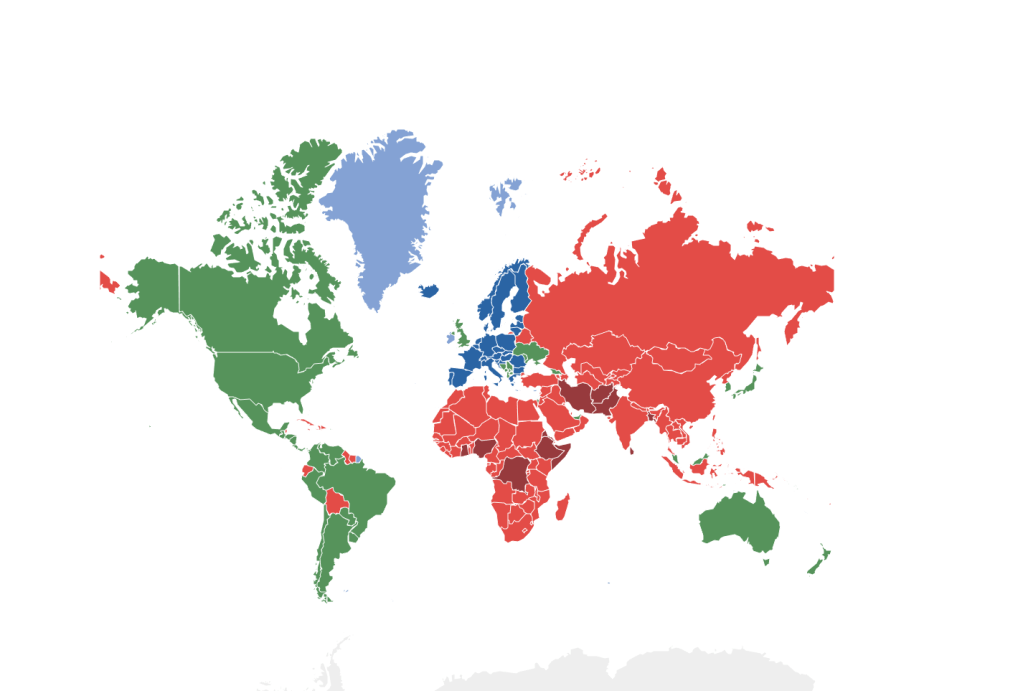
You can check the map below to see if you need a Schengen visa or not:
Blue – Schengen member
Light blue – EU member states (Ireland and Cyprus) and territories of EU member states that are not part of Schengen: Greenland (Denmark), Svalbard (Norway), Guiana (France), New Caledonia (France), French Polynesia – Tahiti, Bora Bora (France), ABC islands – Aruba, Bonaire and Curaçao (Netherlands), St. Maarten (Netherlands and France), Guadeloupe and Martinique (France), La Reunion (France)
Red – Visa required
Dark red – Visa + Airport transit visa required
Exceptions:
There are some categories who are exempted from obtaining a visa such as:
1. Civilian aircrew members – pilots and cabin crew ONLY if they finished duty and have their legal layover for rest. If they come for vacation, they need a visa
2. Civilian sea crew members – same as above
3. Flight crew and attendants on emergency or rescue flights and other helpers in the event of a disaster or accident
4. Civilian crew members on international inland waterways
5. Holders of travel documents issued by intergovernmental organizations
All details on how to obtain the visa, documents needed, costs and the process can be found on the official website of the European Union
I hope this long article has clarified some of the confusions around these two terms.
 Skyline Stories
[…] Greece is part of the European Union and the Schengen Area. […]
LikeLike