
As I mentioned in my previous post about getting to Crete by ferry, not all people get there by plane. There are many tourists that go by car, especially those that cannot fly for certain reasons or stay more than a week on the island. Also, those that stay in Crete over the winter or digital nomads choose this mean of transportation, as renting a car for a longer period, especially in the summer months, can be really expensive. And if you want to wonder around, explore or your accommodation is remote, with limited bus service(mainly in winter months), the car is a must.
I hope the info below helps you plan your journey to Crete by car 😊
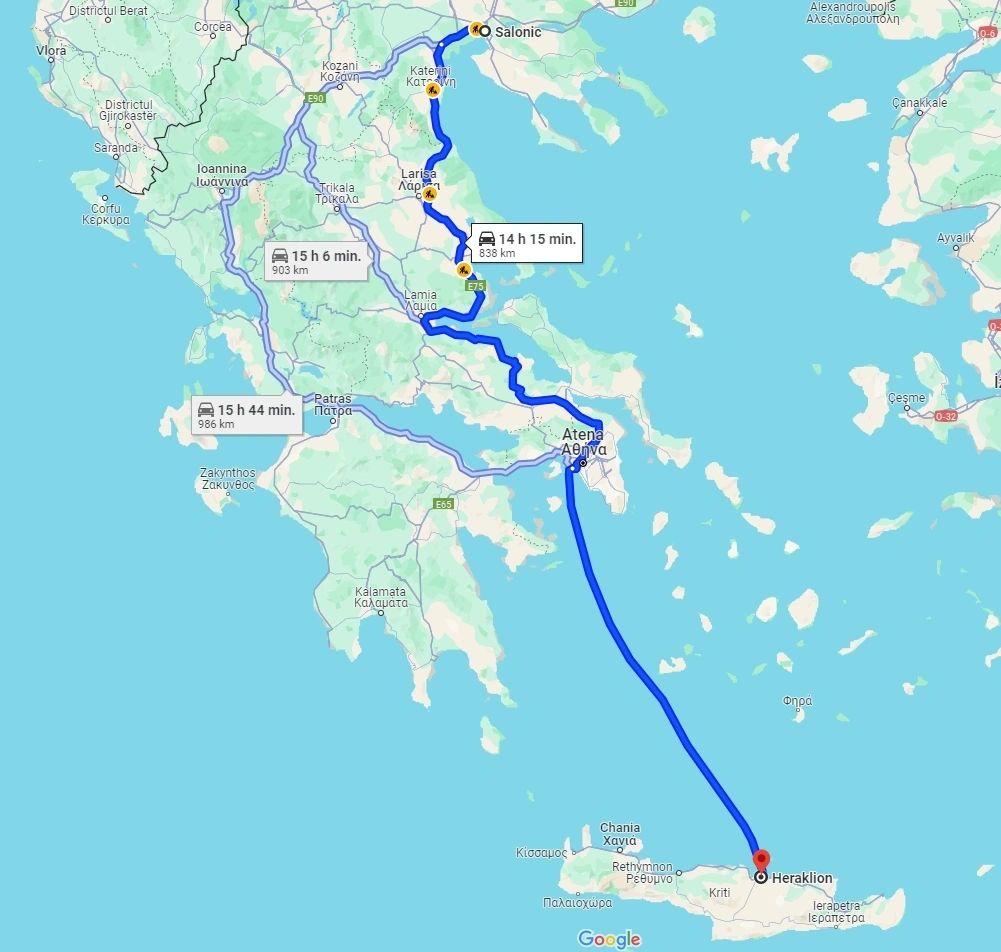
First things first: all roads lead to Athens. Meaning that no matter where you come from, Athens will be your first and main destination. That’s because the ferry will leave from Piraues port, which is right next to Athens. You can use this to visit some other important points along the way, such as Meteora Monasteries and The Ancient Site of Delphi, for example. Athens is located, approximately:
· 1500km from Budapest, Hungary – 15hrs drive
· 1850km from Vienna – 17hrs drive
· 1200km from Bucharest – 14hrs drive
· 800km from Sofia – 8hrs drive
Although Greece is part of Schengen area, it is bordered by non-Schengen countries: Turkey to the east, North Macedonia to north-west and Albania to the west. No matter which country you come from, you will have to pass through border and passport control at:
· Bogorodica – Evzonoi from North Macedonia
· Kapshtices – Kristallopigi or Bote-Sagiada from Albania
· Ipsala – Kipoi from Turkey
Bulgaria and Romania have joined full Schengen area at 1st of January 2025, meaning there will be NO passport control at Kulata-Promachonas and Makaza-Nymphaea.
Unless you enter Greece at Sagiada, you must follow the highway from Thessaloniki to Athens.
Good to know before you go:
1. If your car is not registered on your name (it’s your parents’ or company car) and you cross non-EU countries, such as Serbia, Albania, North Macedonia, Montenegro and Bosnia and Herzegovina you will need a legal document from the owner that you are allowed to drive and make use of it. The document must be issued in English and have the stamp from a local notary or judge.
2. You must have the mandatory car insurance (the basic one in your country, not necessarily CASCO) available for all the countries you will cross to get to Greece. Usually these are issued for all EU countries, but make sure it is also available in non-EU ones mentioned above
3. Depending on your country’s diplomatic relations with the above non-EU countries, your ID might be enough to enter their territory. However, a passport is preferred. Check your Ministry of Foreign Affairs (or how it’s called in your country) website. If unsure, always check with the embassy 😊
4. Expect very long queues and waiting times at border control, especially during the summer. Avoid weekends at all costs, if possible. Northern Greece is a very popular weekend destination for its neighbours that do not have access to the sea or those that live close to the border and it’s much easier to go to Greece for a day at the beach. If you happen to be at the border during the day, in the summer, have enough water with you and enough fuel as you will be spending some hours under the scorching summer sun.
Costs:
1. At least 1 night stay in a location between your departing city and Athens. Usually, Serres or Thessaloniki are chosen as transit places
2. Gas is around 2 euros and diesel around 1.7 euros in Greece. The amount of fuel depends on your car’s consumption per 100km, if you use air conditioning, etc
3. Road tolls. They vary from one country to another and it depends on your route to Greece. In Greece motorway taxes are paid at toll gates or diodia. The price varies from segment to segment. From Promachonas to Athens expect to pay around 50 euros per way
4. Charging stations:
a. In Greece there are 2 Tesla Superchargers – Patras and Atalanti West, 2 superchargers open to other vehicles in Larissa and Athens and 3 Destination charging in Parga, Karpenissi and Artemis. In Bulgaria there are 2 superchargers in Sofia and Plovdiv. In Serbia there are 2 superchargers in Belgrade and close to Nis. In Bosnia and Herzegovina there are some destination charging stations, same in Montenegro. None in Albania and North Macedonia☹
b. You can use the PPC/DEH charging stations that are available all over Greece as PPC is the largest electricity provider in the area. You can install the app, add a card for payment and scan the QR code before charging.
c. Use PlugShare app to find the charging stations along the way. IMPORTANT: not all chargers accept credit cards, RFID cards must be issued, for example Blink. And you cannot install the Blink app, for example, if your Apple/Google store is outside of the country you are trying to pay.
d. In Greece, price is 0.4 euros per kW/h, but it depends on the charging station.
Other things to consider:
· Highways and national roads can be closed without any prior notice in case of wildfire, massive floods, heavy rainfall or snow
· Expect a long drive on highways (in Greece). Take short breaks every 2 hrs
· You are not allowed to stop on the emergency lane on the motorway.
· You can find gas stations with 24/7 amenities (café, toilets, restaurant and snacks) on the motorway
· Tourist buses (travel agencies from the neighbouring countries that bring tourists to Greece by bus) have their pre-determined stops outside the motorway. In any case, should you see them at the gas stations, don’t worry. They only stay for 30 mins or so 😊
· Be very careful where you park, especially in Thessaloniki and Athens. Use the private parking places, with video surveillance and security guards, even though you have to pay. Unfortunately public parking lots are not safe. Lots of car thefts and robberies are reported in these cities, especially in the summer period. I know the general rule is not to leave valuable objects in the car, but you cannot carry all your luggage with you while strolling around in Monastiraki.
From Athens, you will take the ferry to Crete. Remember it usually leaves at 9 pm and you have to be at the boarding gate 1.5-2hrs before.
If you consider you might arrive too early in Piraeus, here are some options to spend the time:
· Stop at Delphi Archaeological Site before arriving to Athens, 2.5 hrs drive
· Stop at Meteora Monasteries before heading to Athens
· Corinth Canal is only 1h drive from Athens
· If you arrive in shoulder season, visit the Acropolis and Athens, especially the Change of Guard
· Go to Cape Sounio – 1h 15 mins from Athens
Have a safe journey!
 Skyline Stories