
When summer is in full right, after the summer solstice, and the season is at its peak, there are some important things I would like to call out. Please take them into consideration, to make the best out of your vacation in Crete, but it also applies to other Greek islands, especially the Cyclades and the Dodecanese.
Extreme weather situations can happen anytime. Have a look on the dedicated weather websites and apps, check the latest travel warnings issued by your country, ask the locals once you arrive and constantly during your stay, be prepared (especially if you have some medical conditions that pose a risk in high temperatures).
As a precaution, make sure your phone is set to receive CBM (Cell Broadcasted Messages). Although this is enabled by default on some smartphones, some users turn if off. These are messages sent by the local authorities (GR-ALERT) in case of any potential danger, such as: severe thunderstorms, massive rainfall hail, floodings, wildfires, extreme wind gusts, extreme heat, etc. The message is sent in Greek and English, either minutes before any immediate danger (now-casting warnings, usually before thunderstorms, massive rainfall and extreme wind gusts) or as soon as a danger has been acknowledged (wildfires) or predicted/confirmed (heatwave). Also, in case of any danger remember to dial 112, the European emergency number, which serves the police, ambulance and fire departments.
Heat waves
Being only 300 kms north of Africa, Crete is hit by heat waves every summer. Usually they “arrive” in early July and mid-August, but in 2024 they were much earlier, starting mid-June. A heatwave, just like the name says, is a mass of hot air coming from the African continent, usually preceded or followed by a wave of Saharan dust. The average temperature in July and August is around 29 degrees Celsius, with a relative humidity of 58%. Being an island, the sea breeze cools down the beaches and nearby areas, keeping the real feel around the same temperature. As I have spent an entire month of August in Crete, sometimes is was so cool at the beach, under the umbrella, that I had to put a towel on and my feet were cold as ice 😊.
When a heatwave arrives, the temperatures skyrocket to 43-44 degrees Celsius. When stepping outside from an area with air conditioning, such as a restaurant or a shop, it’s the same feeling you have when you open the oven door and the hot air hits your face. This also applies in days when there is no breeze or the wind blows from inland towards the sea. Even the beach is like a huge oven, humidity making it even worse. I call it “slow cooking”, because all you do is drink water and sweat like a horse, while sitting on the sunbed and doing nothing.
In such situations, which can be very unpleasant, have the following in mind:
· Go to the beach as early as possible in the morning or as late as possible in the afternoon. Avoid staying in the sun between 11 am – 5/6 pm
· If the above is not possible, as you might be on a day trip visiting some tourist attractions (archaeological sites, cities, etc), wear a hat (or a cap, bandana, etc – have your head covered), sunscreen, light clothes – to allow your skin to breathe and light coloured – white, ivory, beige, light yellow, etc – to repel the sunlight. It is highly recommended to wear clothes that cover as much skin as possible, such as maxi dresses, long sleeved shirts, maxi trousers, etc. Avoid dark colours (black, red and burgundy, blue and dark blue, etc), tight clothes (such as skinny jeans), synthetic fibers and leather and minimalistic clothing, such as super short shorts, sleeveless tops, etc. as you will get not so nice tan lines and even worse, skin burns. You might want to leave at home your favourite team’s T-shirt, as they are not the same quality as the ones worn by athletes, especially if you bought it from Amazon. Trust me, Cristiano Ronaldo’s shirt worn in a match does not cost 50 euros 😊
· Drink water!!! And I cannot stress this enough. Dehydration can have severe consequences, such as hallucinations, loss of time and space sense, nausea, vomiting and fainting. Immediate medical care is needed and you can spend your holiday in a hospital, on infusions, for several days. Avoid salty food, coffee and alcohol, as these speed up the dehydration process
· Avoid very cold drinks, such as ice-cold water. It will not cool you down, instead it will shock your body and you will sweat even more. If that is the only water you found and you are very thirsty, drink it slowly, one sip at a time.
· Eat light food. Avoid minced meat, sauces, club sandwiches, etc. Eat as many fruits and vegetables as possible or salads, to regain the Vitamin C, as this vitamin is soluble and it is eliminated through body fluids. Eat fruits as snacks or ice cream to keep your blood sugar levels in the optimum range.
· Try to drink on a daily basis one sachet of salts. Salts and minerals are a very important need of our bodies and we lose them through excessive sweat.
· DO NOT GO HIKING! Although canyons (such as Samaria and Imbros) are officially closed during heatwaves, small canyons and gorges remain open. People have already lost their lives in the gorges and they were found after many days. The authorities have to conduct search parties, risking the lives of their people and rescue dogs, as the terrain is risky and also during the scorching sun.
· DO NOT JUMP IN THE SEA OR POOL! Enter the water step by step or take a shower before, to accommodate your body with the cold water. Jumping directly in the sea or pool after sitting in the heat can cause severe trauma and even death. The body will receive a huge shock (sometimes a 20+ degrees difference between the air and the water), especially at the pool, where water temperature is sometimes lower than the sea, as the cold water keeps flowing for hygiene purposes.
· Do not wander in the heat by yourself. If you are a solo traveler, either stay indoor in the afternoon or stay close to other tourist groups.
Storms and floodings
Although not that common during the summer months, but these natural phenomena can also happen. A massive thunderstorm can bring a lot of rain and it can cause floodings, like the one from 2022. And here there can be two scenarios: either the air will cool down significantly or it can create a sauna effect.
· In case of a thunderstorm, shelter immediately. Do not stay in open areas, such as large beaches, as your body will become a lightning rod
· Do not go hiking if there is a slightest sign that a thunderstorm will occur.
· Do not wonder in remote mountain areas after a storm or go hiking in the canyons. Floodings can happen at any time, authorities are sometimes taken by surprise.
· In case of immediate danger dial 112 and follow the authorities’ instructions
Wildfires
Every summer Greece is battling wildfires. They can occur anywhere, both on mainland Greece and on the islands. Wildfires are natural or human caused. The natural ones are in very dry areas, with a lot of dry vegetation that catch fire under the scorching sun, just like the savannah ones. As for the man caused… I think there is nothing left to say.
Although Crete is not-so-prone to wildfires, they can happen. A couple of years ago they were in the southern part of Rethymno prefecture and in 2024, in early-mid-June they were in southern Lassithi, between Ierapetra and Makry Gialos. Usually the wildfires start in remote areas, not threatening the tourist ones. And even if that happens, the authorities’ top priority is to evacuate the areas and bring people to safe zones. The fires are being controlled by the firefighters, but their biggest enemy is the wind. Any change in wind direction or speed can spread the fire even more, making it almost impossible to be contained.
· If a fire warning has been issued, avoid that area at any costs!
· Even if you are trying to help, the firefighters might refuse it. If you are not experienced, you end up slowing them down, as they have to care for your safety as well. Best you can do is give them water and food and let them do their job.
· If you are unfortunate enough to be in a fire area, wait and follow the authorities and firefighters’ instructions!!! Cover your nose and your mouth with a mask or a cloth, stay as hydrated as possible, keep a bag with your personal belongings (passport, phone, battery, medicine, basic hygiene products and some spare clothes) at hand, in case of emergency evacuation. Children must be supervised at all times.
· In order to prevent any wildfire, local authorities can prohibit the followings:
o Any use of open fire, including barbeques. So don’t be upset when the host does not allow you to grill some souvlaki in their backyard. Or you don’t find antikristo lamb at a taverna that usually has it in their menu, even if you drove kilometers to get there.
o Any use of pyrotechnics, such as fireworks, including on private boats. A forest on the island of Hydra recently burned because of fireworks used on a private boat party.
o Smoking in some areas, such as beaches or gorges
o Any entrance to canyons and gorges
o Any transport of inflammable substances (such as gasoline or diesel in containers)
o Any controlled burning, such as dried vegetation, twigs and branches, etc
High wind speed and rough sea
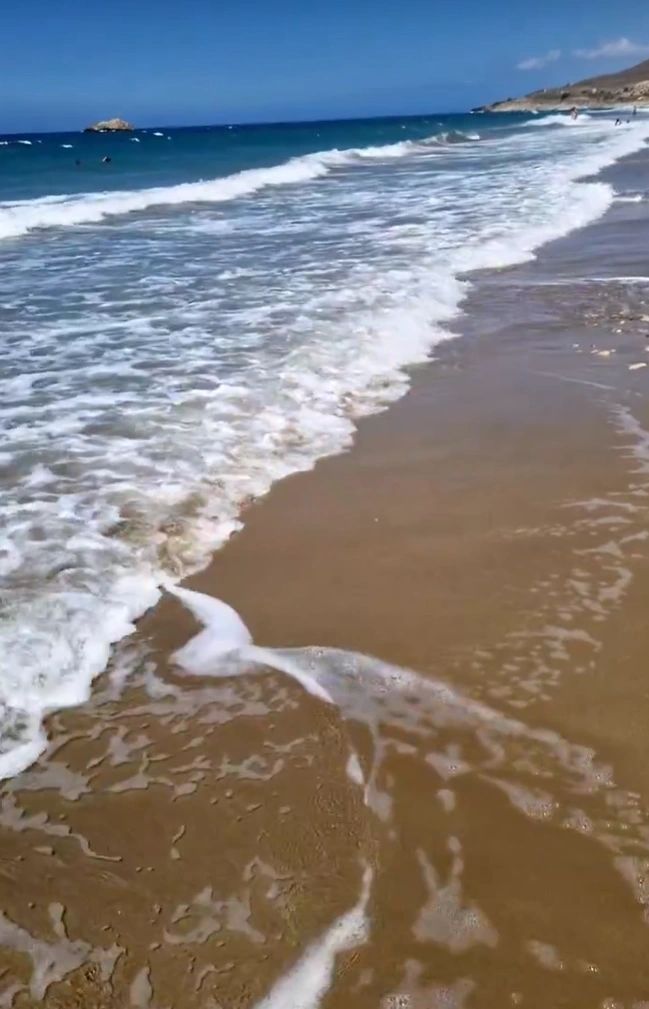
This is the most common vacation disaster, especially from mid-May to mid-September. The main culprit here is the meltemi wind.
Meltemi (or Etesian) is a very strong northern wind, that originates in Asia and swipes through the Aegean Sea. Sometimes it can be so strong, that it disrupts the public ferries and even huge cruise ships. It reaches its peak in July and August. The locals receive it with open arms, as it cools down the temperatures. It may blow for a single day up to a week, but an average is usually 1-2 days. It is stronger in the afternoon.
This wind hits almost all Aegean islands, so if you see windmills on any postcard from the Cyclades, you know what to expect 😊. On its way south, meltemi first hits the Northern Aegean Islands (Samotraki, Limnos), the Sporades (Skopelos, Alonissos) and western Evia, but the full blown is taken by the Western Cyclades (Tinos, Andros, Mykonos) as they lay directly in its path. Then it hits Paros, Naxos, Ios and Santorini. By the time it reaches Crete, it has almost lost its velocity, but if it’s really strong, it can be felt here pretty bad. Its speed ranges between 4-7 Beaufort (11-33 knots or 20-61 km/h) and sometimes it can even reach 8-10 Beaufort (34-55 knots or 62-102km/h), when ferries are cancelled. It can also disrupt landing and take off at Heraklion airport, due to its position. You can also expect moderate turbulences at take off or landing.
The gale (as it sometimes called) also brings moderate to high waves and you can determine the wind direction by the sea foam, which is blown in the direction of the wind.
· High wind speed and high waves means that the red flag will be displayed on the beaches.
· Swimming is strictly prohibited while the red flag is displayed. There is no lifeguard on duty! They do not monitor the beaches, as they don’t risk their lives for some idiots that don’t follow the rules or think that it will never happen to them
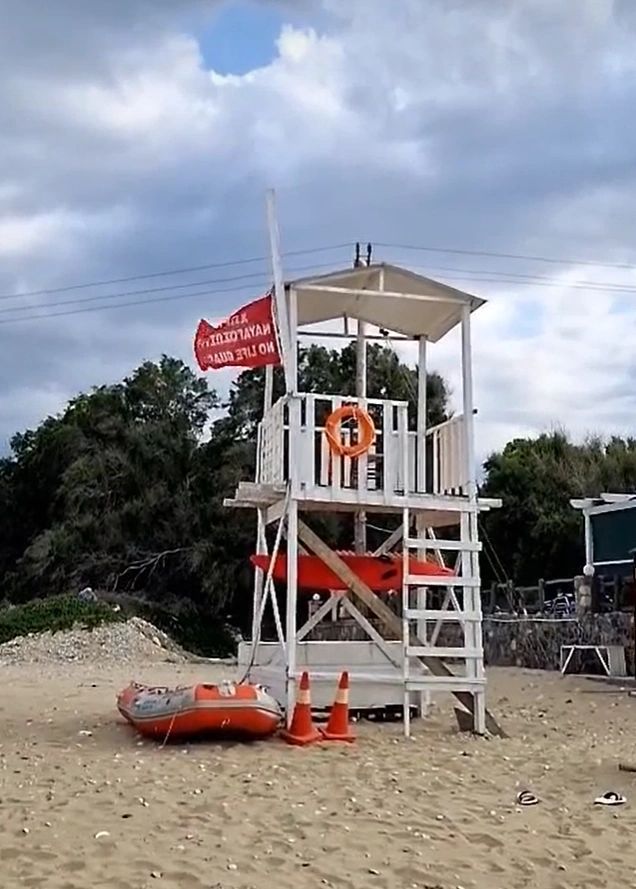
· Even locals stay on the beach, the farthest they go is knee-length
· Children must be supervised and not allowed to enter the sea
· The current is very strong. Even if you are ankle-deep into the sea, it is strong enough to imbalance a 90kg man.
· It is very unpleasant, as it carries sand grains and small pebbles and the feeling when it hits the skin is that of hundreds of stings at a time.
· Light garbage is picked up, such as plastic bags, cups, napkins, umbrellas are used with difficulty.
· It can give the feeling that you might be taken away, can cause inconvenience when waking against the wind
· Waves can reach up to the middle of the beach, making it impossible to keep anything on the sand. Last year I almost walked home barefoot, as it swept away my flipflops
· If you are caught while at the beach, cover your skin (with a towel), wear sunglasses all the time, be careful with your light belongings (such as clothes, towels, inflatable toys, hats) and cups placed on the beach table. Try not to light a cigarette.
· At the accommodation, use clothespins to secure your wet towels and clothes. Close all windows, shades and mosquito nets during the day, to avoid unpleasant situations (such as windows smashing)
· Try to stay away from the trees, don’t walk under the balconies. Avoid outside tables
Have these in mind if you encounter any of the above situations. Drink water! Stay safe and healthy!
 Skyline Stories