
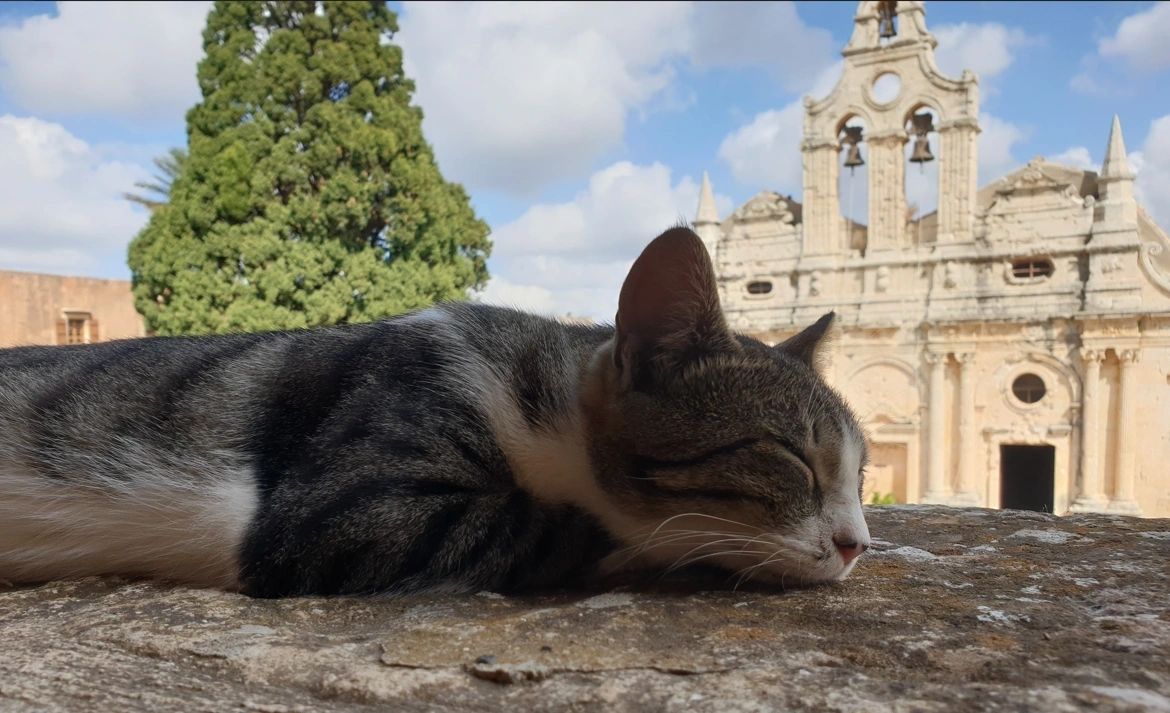
One of the most iconic places in Crete is Arkadi Monastery. Its façade appears on all tourist leaflets that promote the island, together with the beaches of Balos, Vai, Preveli and the landmarks of Heraklion (Koules), Rethymno (Fortezza) and Chania (Venetian Harbour and Mosque).
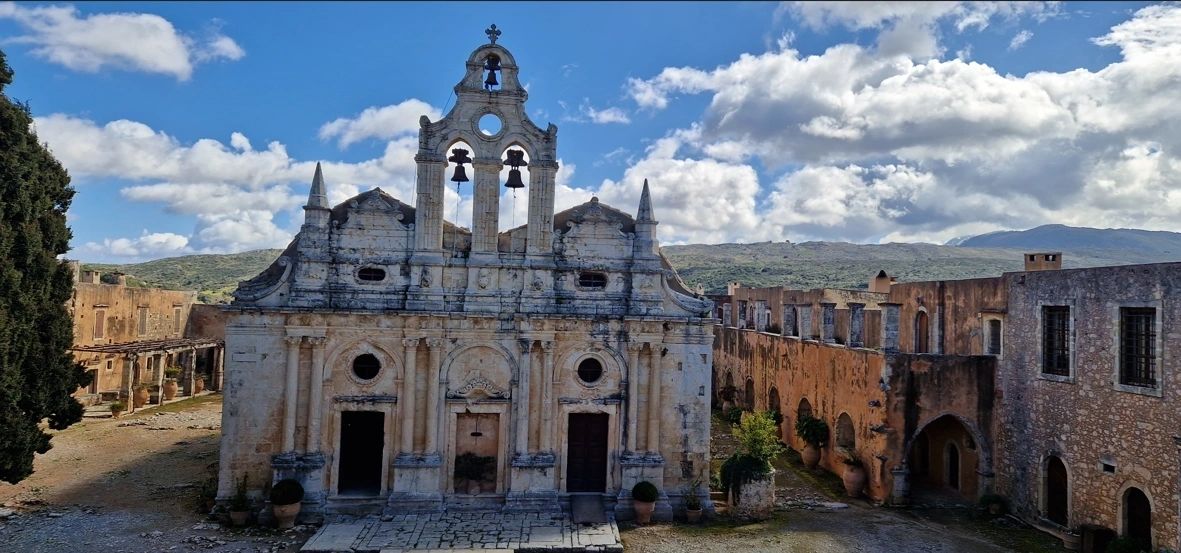
Arkadi (Μονή Αρκαδίου – Monastery of Arkadi in Greek) has played a crucial role in the Cretan history, mainly in the Cretan Revolt of 1866 and it is today one of the most visited places on the island. As a tip, if you go during peak season (July and August), arrive as early as possible, to avoid the crowds.
It is located in the Rethymno Prefecture, just 23kms southeast of Rethymno City. So if you stay in the area, it is a must see. I have been there twice. First in 2020, on our way to Rethymno (where we had accommodation) and then again in 2023, when I went with my mom to visit again the beautiful town (I will detail it separately). Every time I found it so beautiful, I have discovered new details (that I missed during my first visit) but above all I found it very quiet (the perks of travelling during pandemic times and off-season) and peaceful. It is one of those few places that still preserved their holy place vibe.
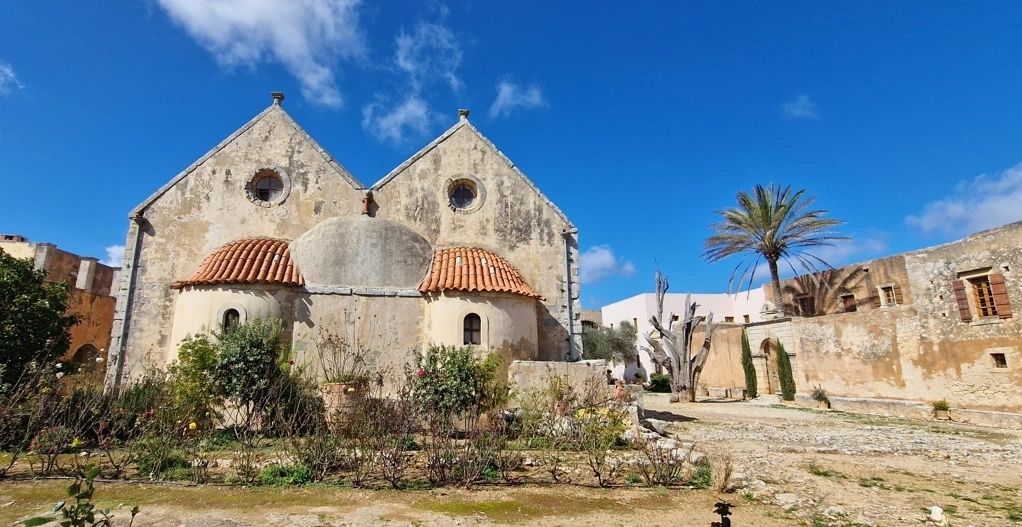
As many monasteries in Crete, Arkadi is also a fortified one. Inside the nearly rectangular walls you will find the church, the monks’ cells (yes, it is still inhabited by monks), the hegumen’s house, the stockrooms, the powder magazine and the hospice. Also, there is a museum and a small souvenir shop, selling mainly religious objects (icons, frankincense, holy oil, etc).
The exact date when the monastery was founded is unknown, as it has been through a lot of restorations, but people think it dates back to the Byzantine era and that it took its name from the emperor Arcadius, who ruled in the 5th century AD. First restorations started in the 16th century when the monastery thrived, from both economical and cultural perspective. The Ottoman invasion in the 17th century allowed the monastery to be rebuilt, according to its original plans, however the monks abused this right and added new buildings (because why not? 😊 )
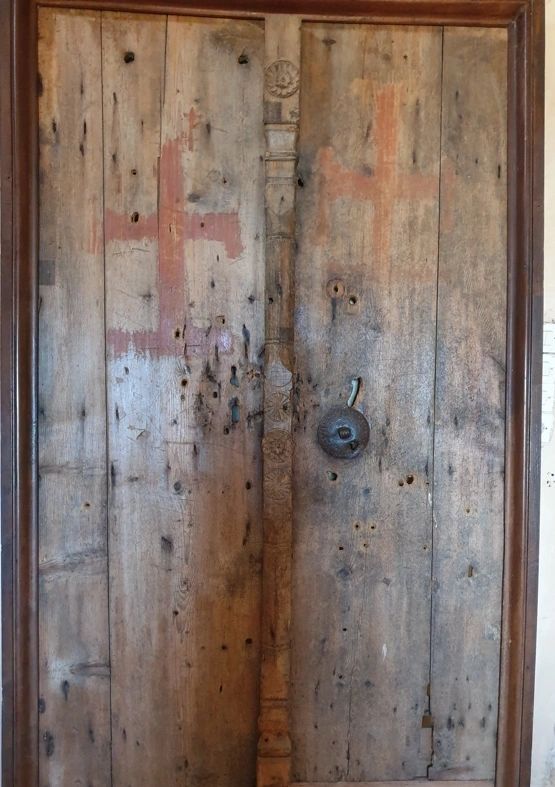
During the Cretan Revolt, 964 people sheltered inside its walls: 325 men (only 259 were armed), the rest women and children. On the 8th of November 1866, when the Orthodox church celebrates the day of the Archangels Michael and Gabriel, the monastery was assaulted by the Ottomans. In the first day, the Turks suffered serious losses, as the Cretans were protected by the walls. In the next day, the Ottomans managed to break the barricaded main door and enter the building.
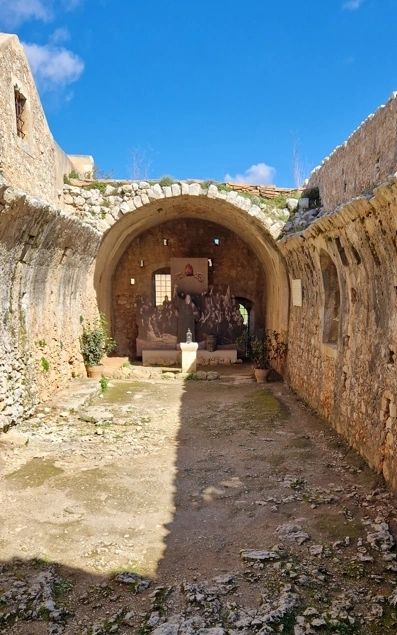
The women and children were hiding in the powder room, the Cretans were running out of ammunition so the path of Turkish conquest was now open. When the Turks arrived at the door of the powder room, Konstantinos Giaboudakis set the barrels of powder on fire, killing almost everyone inside and also causing serious losses in the enemy’s troops. In another room, insurgents made the same gesture, but they were not that lucky. The powder was humid and it only managed to destroy a part of the room’s wall. In what is called “the Arkadi Holocaust”, 846 Cretans were killed in combat and 114 men and women were captured and sent to prison. They were humiliated on their way to Rethymno by the officers and Muslim population and the men were imprisoned for a year in difficult conditions, so inhuman that the Russian Consulate had to intervene to request the Pasha to provide basic hygiene conditions.
Even though the Ottomans celebrated the taking of Arkadi with canon fire, the event provoked indignation among the Cretans and the rest of the world. The Cretans have been praised for their patriotism and their wish for independence, from major figures of the time, such as Giuseppe Garibaldi and Victor Hugo. The events are also mentioned in Nikos Kazantzakis novel, “Captain Michalis” (Ο Καπετάν Μιχάλης), also known as “Freedom or Death” (Ελευθερία ή θάνατος), which is also the motto of Greece.
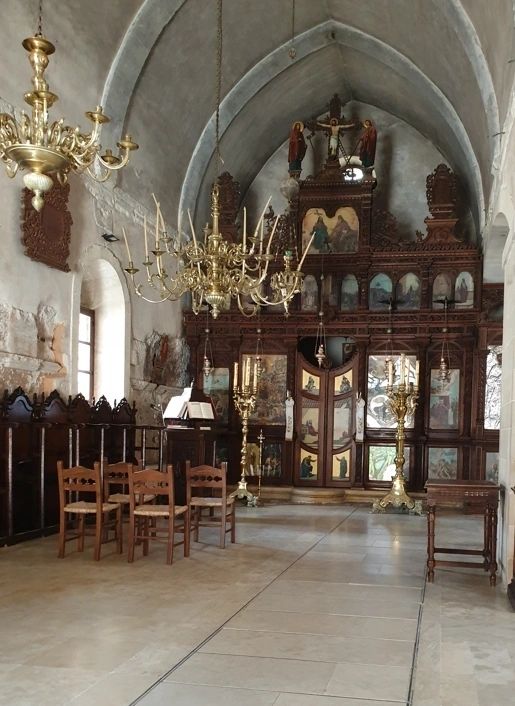
Today the monastery can be visited and it is sometimes included in the day trips to Rethymno, organized by local travel agencies. You can visit the church, the Historic Dining Room, the Powder Room (where a memorial has been built), the museum and the art gallery. Also, you can wonder its courtyard and enjoy the silence. The monastery celebrates three major Orthodox holidays: 21st of May (St. Constantine and Helen), 6th of August (The Transfiguration of Christ) and 8th of November (Archangels Michael and Gabriel, but also the day of the Ottoman assault).
The church is a basilica with two naves: the northern one is dedicated to the Transfiguration of Christ and the southern one to St. Constantine and Helen. The architecture has been heavily influenced by the Renaissance, as it was built when Crete was a colony of the Republic of Venice, therefore its not-so-Eastern-Orthodox look 😊
Good to know before you go:
· It is a holy place and inhabited by monks. Divine liturgies take place according to Orthodox rites, every Sunday, and also holy ceremonies every morning (6 a.m) and evening (5 p.m). in the summertime, the visiting hours are until 8 p.m., so please be considerate if you get there during the ceremonies.
· Please be properly dressed, especially as a woman. No super-shorts, revealing clothes, bikinis, etc.
· Please keep quiet, as it is a place of commemoration and divine adoration
· It is a very sensitive place for the Cretans, it is a place where their ancestors preferred to blow themselves up instead of falling in the hands of the Ottomans. It is a place of grief, so be considerate when you post pictures on your social media. Do not use stupid hashtags and respect the place’s history
· The entrance fee is 4 euros, money is used for the restoration of the place. You can buy tickets directly at the ticket office or online
· Toilets are outside the walls, free of charge
· There is a large parking lot at the entrance
· You can get there by bus, you have to take it from Rethymno Central Station, towards Panormo. It will be the first stop. Also from here you can go to Ancient Eleftherna and Margarites 😊

· If you go by bus, make sure that you don’t miss the one back 😊 There is no other way to get to Rethymno. Take the 11 a.m. bus to Arkadi and the 13:45 one to Rethymno, for example.
· Do not disturb the cats 😊
 Skyline Stories