
Hello there!
My previous posts have been about general stuff, but now it’s time to talk about Crete and it’s must see places.
A little bit of history to start with.
Well, this land is always seen as the cradle of the Europe and ancient Greece, as history records tell us. And that is because of the Minoan civilization.
It all starts in ancient Greek mythology. Zeus, the ruler of the Greek gods and Mount Olympus, fell in love with one of Agenor’s daughters, Europe. He abducted her disguised as a white bull and she was brought to the island, where she gave birth to King Minos, mostly known for the Labyrinth and the Minotaur legend. But the mythology part goes even back in time. When Zeus was born, his mother Rhea hid him in a cave in Crete, so that his father Chronos would not eat him. Currently the cave is a tourist attraction known as the Cave of Zeus – Diktaeon Andron, in the Dikti Mountains, Lasithi.
The Minoan civilization was an advanced one for its time (Bronze Age, around 3200 BC, more than 5000 years ago). It was a literate people, highly developed and the ruins of the major Minoan palaces (Knossos, Malia, Phaistos, Zakros) are the proof. The Minoan civilization is thought to have disappeared around 1600 BC, almost at the same time as a major cataclysmic event occurred in the Aegean Sea, i.e. the massive volcanic eruption of Thira (what we know today as Santorini). The strong earthquake was felt on Crete and most probably the shores were hit by building-size waves.
I will start the journey through the Minoan times with the most important archaeological discovery and the image that you see on almost all postcards from Crete.
KNOSSOS PALACE
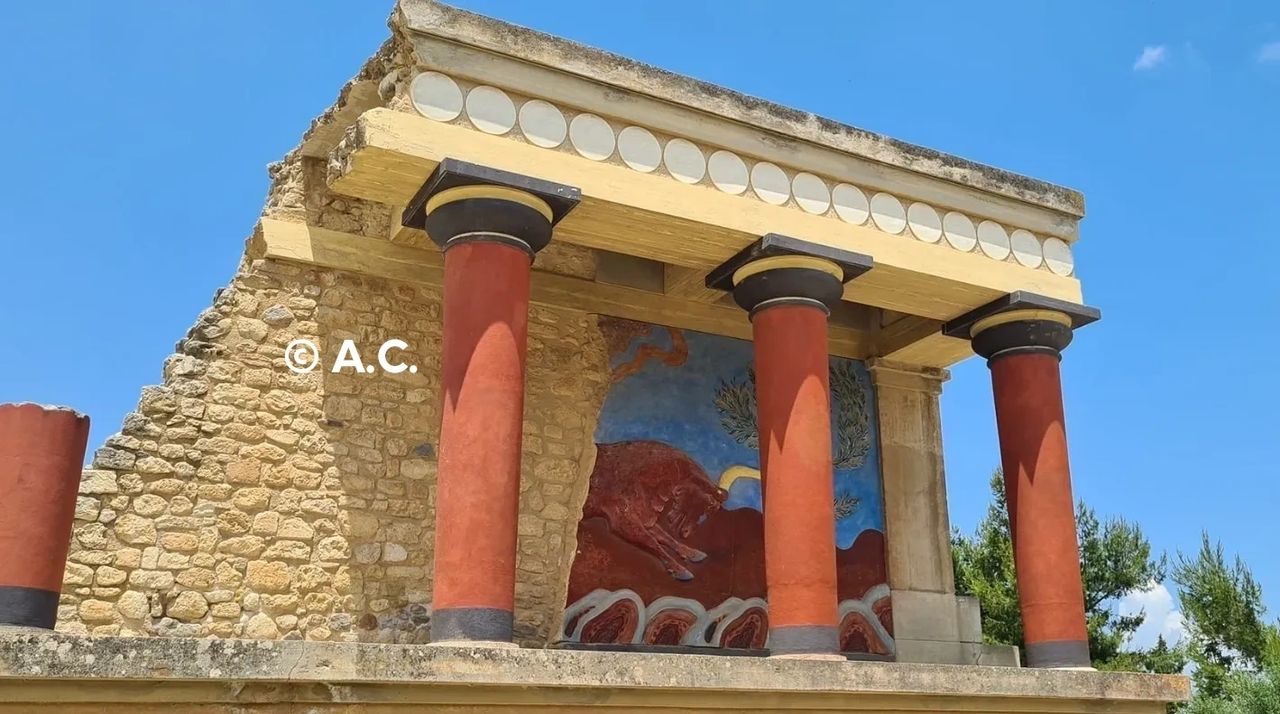
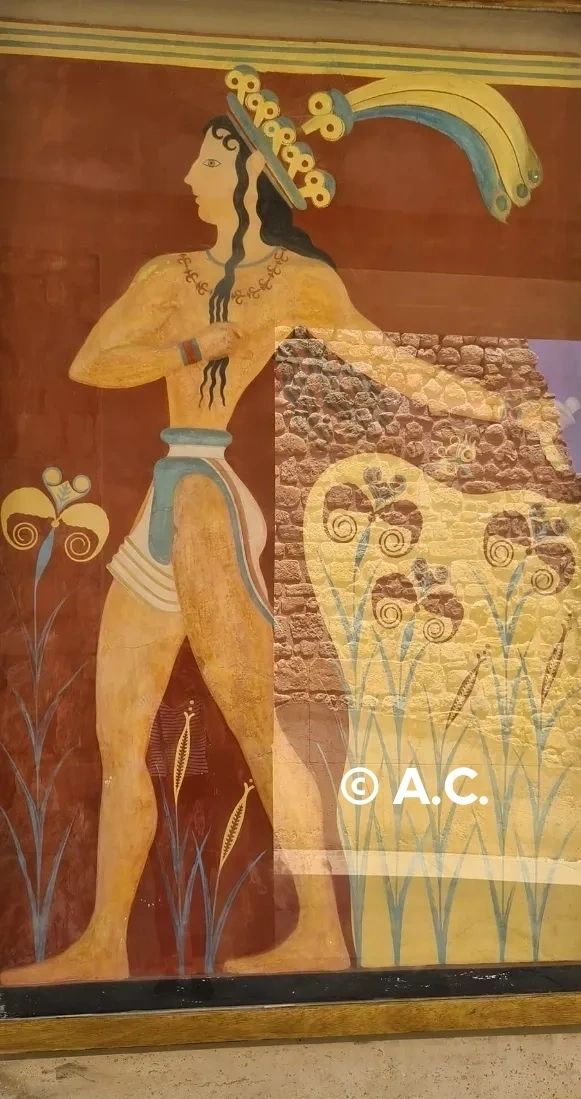
Knossos Archaeological Site is located south of Heraklion at approx. 5 km. It was excavated and reconstructed by Sir Arthur Evans, based on old frescoes. It is said that the famous labyrinth, home of the Minotaur, was located under Knossos Palace. With the help of recent technology, scanning has revealed that there is nothing as such underneath, only drainage.
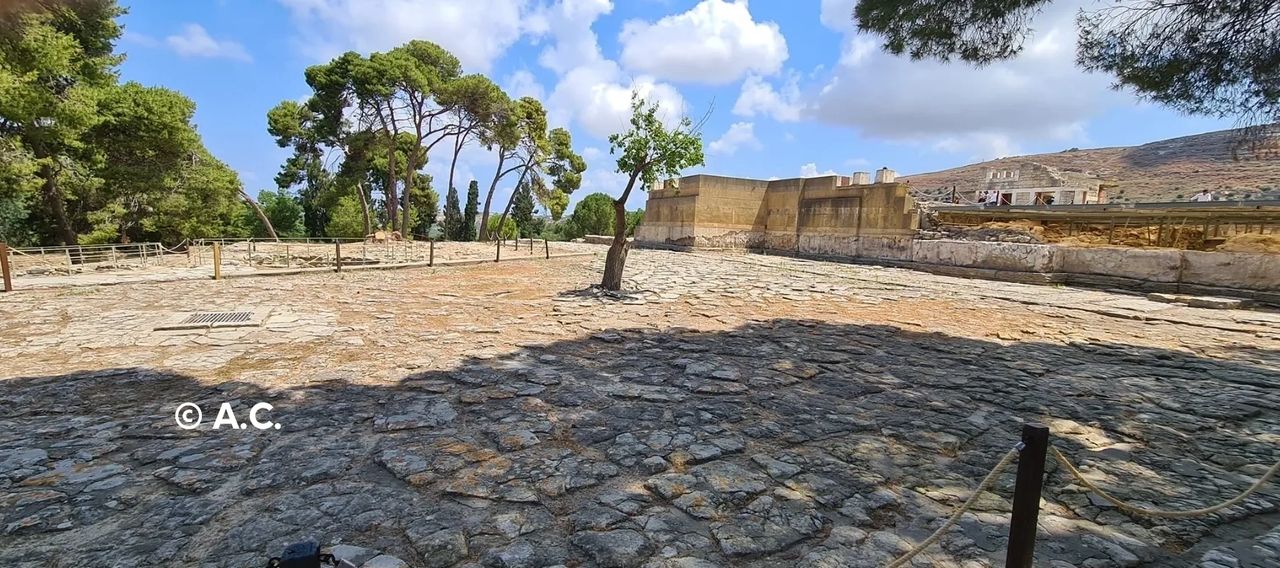
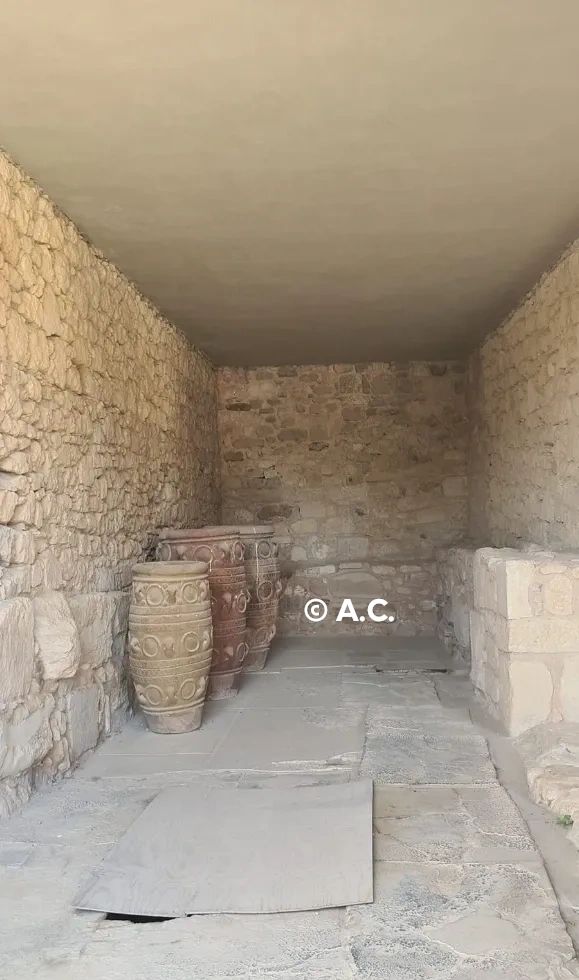
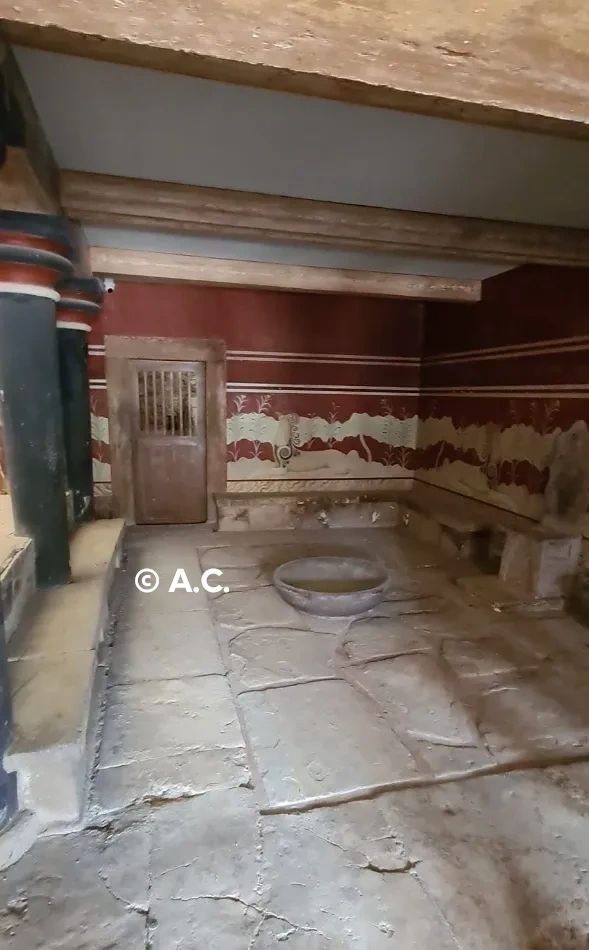
In it’s glory days, Knossos was a large and important site for the Minoans. It had a throne room, storages, magazines, water system (for supply, drainage of runoff and drainage of waste water, pretty similar to nowadays plumbing system). Aqueducts were used to bring fresh water from the Archanes area, approx.. 10km away (told you they were pretty advanced). Also, its location received sea breeze and it had ventilation shafts. I will not insist on all the historical details, as all these can be found on their website or on Wikipedia 😊

Nowadays Knossos is open to the public and it can be visited. It is a must see if you go to Crete. I visited it twice. First time in 2020, but we were in a hurry and most of the site was closed, because of pandemic restrictions. Last year I visited it again, this time at my own pace and I could enjoy the place. Being a huuuuge history geek, visiting archaeological sites is always on my to-do list.
How to get there:
1. By Car. The best way, this is how I got there the first time. There is free parking available, 5mins walk from the site entrance. Keep in mind that during summer months parking spaces might not be available, so arrive as early as possible.
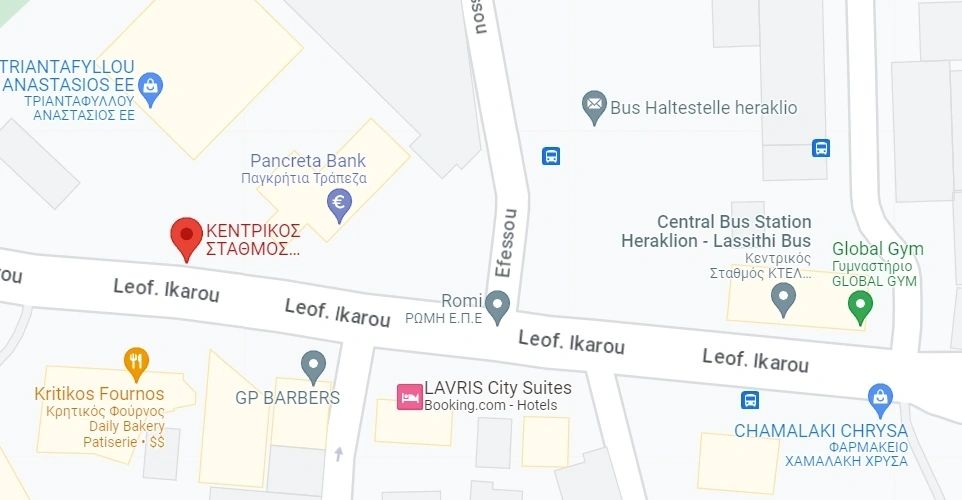
2. By public transportation. There are 2 buses that stop at Knossos. Number 2 and number 20. The easiest way to get there is by bus number 2. You can take it from Central Bus Station in Heraklion (NOT the main one, but the station in front of the PanCreta Bank) or at Astoria Hotel, in City Center, next to the Archaeological Museum. The bus ticket costs 1.6E if bought from the ticket office and 2.5E if bought at the driver, it is the blue ticket, for B zone. As a point at Knossos, look for Pasiphae Taverna on the left. Usually the driver announces the station as many tourists use the bus.
3. By organized day trip, booked from a local agency or from your tour operator. It is usually combined with Heraklion. Please note that only certified guides (aka Greek citizens) are allowed to escort you in the archaeological site and do all the explanations. So if you buy the trip from Get your Guide, the trip manager (as they are called) might not be allowed to enter and all the info will be provided inside the bus
Tips and tricks 😊
· Buy your ticket online. You can do it from their website and you skip the line. Trust me, in 2022, early June, when tourism was still latent after restrictions, the queue at the ticket office was in the street.
· Go as early in the morning as possible, to avoid the tourist buses and the crowds
· Wear comfortable shoes (you’ll se in the pictures why), sunscreen and a hat. The site is in the open and the sun is shining almost all the time
· Have water for hydration, expect to spend around 2hrs here.
· Please be considerate, as it’s an archaeological site, very important to human culture and Greek heritage. Try not to touch the objects and do not climb on the walls, not even for an innocent Instagram picture. Keep it clean and follow the guides’ and the guards’ information and rules.
· Inside there is a cafeteria and there are toilets as well.
· Buy a combined ticket from the Archaeological museum in Heraklion. It is valid for 2 days, skip the line included. Also, it is cheaper than buying 2 separate tickets
Enjoy!
P.S. All pictures are from my personal archive, therefore watermarked with my initials. Please do not use without permission. Thank you!
 Skyline Stories
[…] Early in the morning I went to Knossos, as I already had the ticket bought. I have detailed the visit here […]
LikeLike
[…] Marvels: Stand in awe at the Acropolis in Athens, explore the Palace of Knossos in Crete, or wander Delphi’s ancient […]
LikeLike