
In my previous post I have presented in details the traffic rules in Crete, which are available all over Greece. Now, let’s see how it is to drive in Crete.
I am a professional passenger 😊 . With that being said, I pay much more attention to details and the surroundings than the driver, who is mainly focused on the road.
Let’s take them one by one.
1. Traffic in general
· Even in high season, traffic is quite OK. Yes, traffic jams can occur, but they are mainly in big cities, but don’t think it looks like New York or London at commute time. I stayed outside Heraklion and the longest drive to the city was around 20 mins (usually a 10 mins drive), in the morning.
· In July and August you can expect some delays or traffic jams in highly populated tourist areas, such as Hersonissos or Malia (near Heraklion) or Platanias or Agia Marina (near Chania). This is because tourists rent cars to explore the island
· Cretan drivers are polite in traffic (there are exceptions, of course), they do not rush, συγα-συγα is their motto, so don’t honk them, please 😊. You will often see 2 cars stopped in the middle of the road, coming from opposite sides and the drivers chatting. They won’t move until they are done with their talk, even if they see that they blocked the road. All you can do is wait 😊
· At popular tourist destinations, expect to find few parking spots (or none at all, depending the time of your arrival). Also, keep a good distance between you and the car in front, especially in places with high elevation and slopes (such as Seitan Limania, the gorges of Topolia and Kourtaliotiko)
· You will see that the locals don’t drive expensive cars, most of them looking like they are about to collapse in the middle of the road or they would never be granted the technical inspection check in other European countries. They don’t care. If that car can take them from point A to point B, there are no issues.
· You might see cars with license plates that do not look new or do not match the EU standard (the EU flag and the country code on the left, standard font, etc). There is no issue in that, as Greece hasn’t changed their license plate format. The Greek license plates follow a national standard: 3 letters representing the area/city code (HKN, HKI for Heraklion, XNA, XNI for Chania, ANK, ANI for Agios Nikolaos, etc) a hyphen and then a combination of 4 digits.
2. Roads and traffic signs
· Roads are in very good condition, even in remote areas.

· Traffic signs follow the standard European rules, but they are more… vivid (let’s say more accurate to reality, rather than silhouettes)
· They are written in Greek and in Latin alphabet. The Latin alphabet name is in white colour and is the phonetic transcription (e.g. Ηράκλειο – Iraklio, Χανιά – Chania)
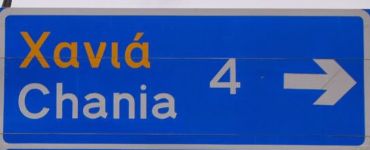
· Traffic signs might be missing in rural areas, because… why not? 😊
3. Local flavours
· You might encounter traffic jams caused by sheep or goats, especially in the mountains
· In the countryside, locals don’t use the signal lights, so keep a good distance between you and the car in front, as you might have to guess their intentions
· The locals tend to ignore the traffic signs, prohibitory markings, etc. Don’t do that 😊
· Uncle Manolis might drive to the kafeneio, have a couple of raki shots and then drive back home. Or he might call his 16 years old nephew, Giannis, to pick him up, even though Giannis is underage and doesn’t have a driver’s license. Don’t do that either, under any circumstance! 😊
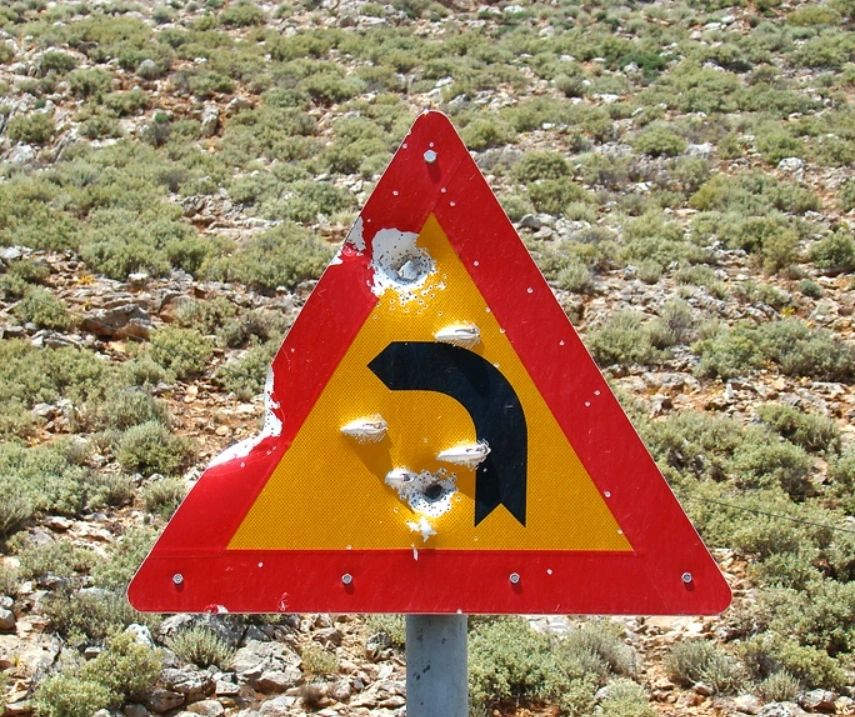
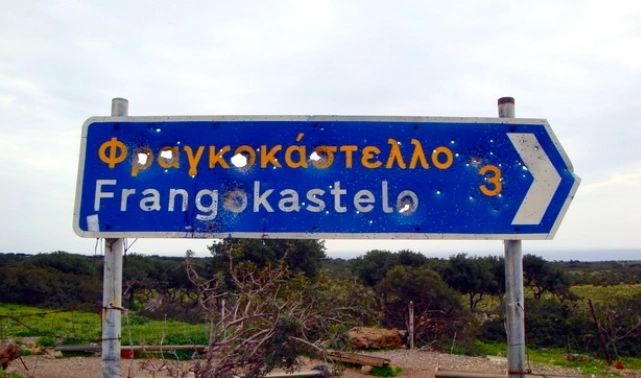
· Some road signs look like they have bullet holes. Actually, they do. During WW2, the Allies provided the Cretans with weapons and ammunition. And they didn’t return them, after the war. So yeah, road signs are used as shooting targets 😊
· Not sure if applicable all over Greece, but the roundabout give way is different. In my home country, the cars that enter the roundabout must give way to those that are already there. In Crete, this is not applicable. You must allow to enter the roundabout the cars that come from your right side.
· Pedestrians don’t have priority when crossing the street, even on the markings. There is a fine for that, but locals tend to ignore it. On the other hand, they allow pedestrians to cross the street on national roads, for example. Still a mystery.
· The drivers understand each other’s intentions and they always get along. Again, still a mystery
· Road signs are either vandalized (graffiti or stickers) or they have been embraced by mother nature. In my area, there was a warning sign for pedestrians and one for speed limit. They were literally in a fig tree, completely unseen by drivers
As a conclusion: do what the law says, not what the locals do 😊
 Skyline Stories